
It was a beautiful April day. The cherry tree outside my office window was in blossom — earlier than in previous years. I had finished the second morning coffee and was midway through a Claude Code session, working through something about social media strategy. While Claude was, as the terminal put it, schlepping in the background, my phone rang.
It was J. He’s the friend and former colleague I started experimenting with machine translation with, years ago. We hadn’t spoken in months, and he had news.
One of our former coworkers was leaving the translator profession entirely. The pay he had been offered a year ago and had been working for since had become too low to live on. He was starting in May as a Logistics Coordinator. Another colleague we both know — degrees in history and in translation — had been driving freight trains in Germany for some time. And J. himself? He had just bought a Tesla. He was starting as an Uber driver, with some interpreting on the side from the work he could still pick up.
J. didn’t sound bitter. He sounded almost energized — about the people he was meeting in his car at odd hours, the conversations they had, the short stories he had already begun writing about them. The writer in him hadn’t died. Only the workflow.
I put down the phone and looked at the cherry tree.
To explain how I came to spend my mornings in a Claude Code session about my own publication while my colleagues become Logistics Coordinators and freight train drivers, I have to start at my grandmother’s typewriter.
I. The Pattern
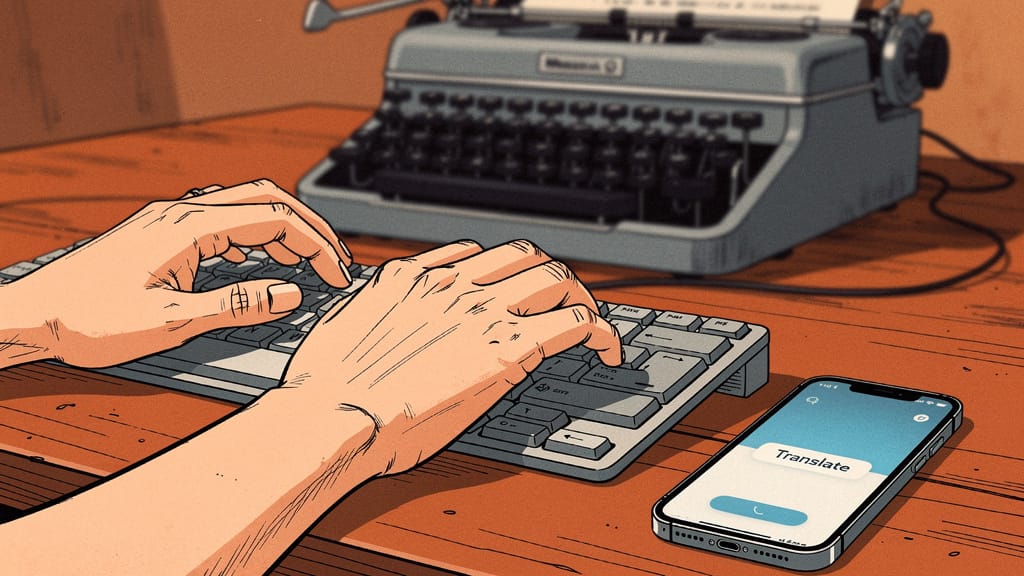
I was born in Czechoslovakia in the early seventies. My grandmother was a language teacher and translator. She had a typewriter with both German and Czech-Slovak special characters, and as a small boy I would sit at it and type sentences and small real-life stories. What I loved was the act of making text. Letters. Languages. The way the same meaning could be carried in two different shapes. I never became a writer. I became a translator — which, it turned out, is the same thing in disguise.
By my twenties I was a freelance translator in early-1990s Czechoslovakia, in the heady transitional period after the Wall fell. Foreign companies arrived in the country looking for managers, and the managers needed translators. There were not many of us. As a twenty-something I would walk into a meeting room of senior managers who commanded dozens of people each, and they would, half-jokingly and half with a kind of bitter irony, hold the door for me. “According to salary,” they’d say. For a brief period, that was true.
My grandmother had retired by then, in her eighties. I told her how text editors worked — how you could move a sentence, undo a mistake, search a whole document. She shook her head and said: “That’s not possible. That’s a miracle.” I remember wondering what would one day make me shake my head the same way.
But it wasn’t only retirees who found the new technology hard to absorb. In 1994 I was working as an in-house interpreter for German management at a car manufacturing factory. There was an executive assistant there in her thirties, Eva, who used to make internal phone directories in Excel — two columns, beautifully framed with lines of varying thickness. One day I looked over her shoulder and saw she had another spreadsheet open and was adding the values in the rows on a calculator on her desk. I offered to show her how to make Excel do it. She smiled and said: “No, no. I’m used to doing it this way. It’s better like this.”
More than thirty years later, I catch myself doing the same thing — knowing there’s a tool that would save me an hour, and reaching for the proven method anyway. This is not a story about other people being slow.
II. The Lens
At the start of my career, I used to joke that an interpreter walking into a corporate meeting room where multiple departments had been summoned needed only one sentence: “That is not our department’s responsibility.” Master that in both languages and you’ve covered eighty percent of what you’ll be translating.
The joke hid something real. Every department I interpreted for had its own jargon, its own culture, its own view of the company — and, almost always, a blind spot where the next department began. Production couldn’t see why marketing made promises. Marketing couldn’t see why production couldn’t deliver. To be good at what they did, their view probably had to be narrow. As the interpreter, I sat at the seam — and built up a kaleidoscope of my own: dozens of roles, departments, and industries, each with a place where their sight line ended.
The kaleidoscope found its sharpest focus in one particular kind of assignment: ISO certification audits in factories across the country. The auditors went department by department — CEO, marketing, production, warehousing — and demanded a detailed account from each role. What is the job. Where is it described. What are the inputs. What are the outputs. As the interpreter, I had to understand it well enough to render it in two languages, in real time. You don’t spend years doing that without learning what jobs across the economy actually consist of.
III. The Disruption
I built up a small translation agency with a language school as a partner. By my early forties I realized I had been so absorbed in language work that I had never made time for my actual hobby, computers. I went back to school. At forty-four I earned a bachelor’s degree in IT, intended to future-proof my career.
It future-proofed nothing. AI came for both sides.
When Google Translate arrived, most of my translator colleagues laughed at the output. “Computers will never replace us. Language is too specific.” J. — the friend from the phone call — and I were in the smallest minority — the ones who looked at it and thought, this is an opportunity. Where clients didn’t restrict it, we built the new tools into our workflow.
Then a generative model surprised me on a particular set of texts. I recommended it to J. and asked him to try it. We both had to admit what we were looking at. A lot of sentences came back better than either of us would have written them. Generative AI wasn’t a tool we were using anymore. It was the future of the profession.
Around that time, at a family celebration, my fourteen-year-old niece — who knew I was running a translation agency — looked at me with open puzzlement. “Uncle, I don’t understand. Why don’t your clients just put it into ChatGPT?”
IV. The Publication
When ChatGPT arrived, what got my attention was not the chat window. It was what you could do once you stopped chatting and started calling the model from code: vector databases, retrieval systems, deterministic algorithms wrapped around a language model. The IT degree, the C# work, the years inside corporate meeting rooms as an interpreter — all of it suddenly rhymed.
I was convinced early — even if the world stopped all further AI development and just implemented what was already available, the transformation of work would be enormous. I started telling everyone. Most people thought I was exaggerating.
Yes — the publication about AI is built with AI. I use a deep-research API for primary research, an automation platform to orchestrate the pipeline, AI writing models for drafting, AI illustration for visuals. Where AI consistently helps me, I let it. Where it doesn’t — judgment about what’s worth covering, voice calibration, the editorial line — I keep the decisions. My working rule is that the first recommendation, on anything, is average. The good outcomes come from arguing with the model, asking for alternatives, and pushing in the direction that feels right. Sometimes the model pushes back. Sometimes the model wins.
A magazine producing what Jobs After AI produces — twelve or thirteen articles a week, a weekly newsletter, original illustrations on each piece — would have required roughly nine or ten editorial staff in 2020 and an operating budget of six hundred thousand to a million dollars a year. The pipeline I run is one person and a stack of capability-categories. That is the bet.
AI didn’t hand me a business. AI took something away — translation work I had built a career on. But AI also freed up the time to build something I had been circling for years: my own project at the intersection of language and technology. And AI created the topic itself.
I used to play a lot of Scrabble. The game has these red squares where the score on a played word triples. The way to win is to look for the red squares and put your letters there. You don’t sit and brood about the last game. There is only the board you’re holding now.
This is what I’m watching: what’s happening to work as AI arrives. I write it for the people who are already inside that change — like J., on the road in his Tesla — and for the people one wave behind who can still see it coming.