

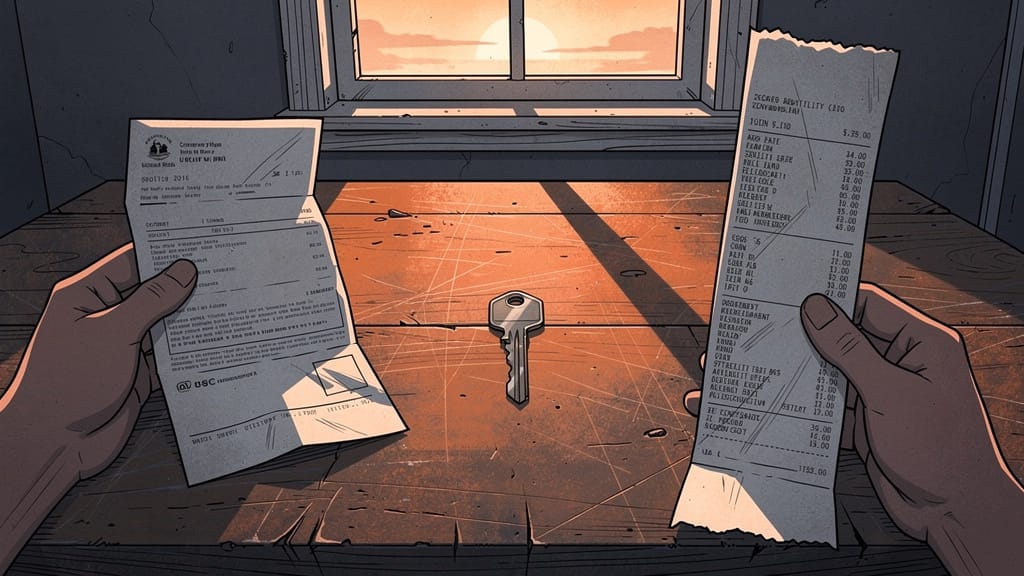
Yves Valerus still had her job. That's the part that makes her story so useful to pay attention to.
She was a Haitian Creole-English interpreter working remotely for LanguageLine Solutions — handling hospital calls, court proceedings, and life-altering moments for people who needed her to make sense of it all. For a year and a half, she had a stable schedule, a regular hourly rate, and benefits. Then in 2025, her employer introduced new scheduling software. Her shifts started breaking apart with little notice. Unpaid gaps appeared on her calendar. By the end of the year, NPR reviewed her tax forms and confirmed: her income from LanguageLine had fallen 18%. She began prioritizing her internet bill over utilities — she needed the connection to work — and traveling three extra miles to buy groceries on sale.
The AI didn't fire her. It didn't replace her voice on a single call. And yet her financial life had materially changed.
That's the story the headlines miss, and it's why the question "Will AI take my job?" is actually the wrong one to be asking.
The Three Things Everyone Calls "AI" — and Only One Is Already in Your Paycheck
When people say "AI is coming for interpreters," they're actually describing three different mechanisms with three different timelines. Only one of them has already changed what interpreters take home.
Lane 1 is AI managing your schedule. This is what happened to Valerus. LanguageLine deployed NiCE, an AI-powered workforce-management platform, in 2025. Workers described their minimum buffer between calls shrinking to 15 seconds — down from the several minutes they'd had before. In a CWA survey of 161 LanguageLine interpreters, 76% strongly disagreed that they had enough recovery time between calls. The software forecasts call volume, optimizes shift fragments, and generates "mandatory involuntary time off" on short notice. No automated voice replaced Valerus. An algorithm decided when she worked and when she didn't. This lane is live, and it's already affecting paychecks.
Lane 2 is AI handling some calls — specifically the simplest ones. LanguageLine is piloting automated interpretation in more than 10 languages for what it calls "high volume, low risk" interactions. Think appointment reminders and prescription refill notifications. Some interpreters report seeing fewer of those routine calls in their queues. This lane is real, but it's early and narrow. Only 16.8% of interpreting organizations currently use AI interpreting at all, according to a Boostlingo survey of more than 370 stakeholders from April 2026. The technology is expanding, but slowly, and it's targeting the most standardized work first.
Lane 3 runs in your favor. In April 2026, AIIC — the international conference interpreters' association — ran a professional development course in Bangkok specifically teaching working interpreters to use AI for glossary creation, terminology extraction from documents and audio files, and assignment research. Tasks that previously took hours now take minutes. This frees preparation time for the work only a person can do. Lane 3 is available today, requires no special certification, and most interpreters aren't using it yet.
Knowing which lane you're in right now determines what you should do next. Most interpreters are feeling Lane 1 without having a name for it.
Where AI Actually Stops — and Why That Matters for Your Work
Understanding the ceiling on AI's current reach isn't reassurance theater. It's a sourced, evidence-based map of where the technology actually is.
Christina Green runs a language-services firm in Wisconsin and holds certification as a state court interpreter. When one of her Fortune 10 corporate clients switched to an AI translation provider in 2026, she lost enough revenue that she had to make layoffs. And yet she still had her court interpreting work. That split is not coincidental. The corporate client bought standardized language services. The court is bound by a different standard — and in Ohio, by enacted law. The Ohio Supreme Court formally prohibited AI for substantive legal translation or interpretation in court proceedings, effective November 2025, citing risks to litigants' rights. The National Center for State Courts advises the same.
People and companies think they're saving money with AI, but they have absolutely no clue what it is, how privacy is affected and what the ramifications are.
— Christina Green, language-services firm president and certified court interpreter
The research bears this out in clinical settings too. A peer-reviewed study published in May 2026 in npj Health Systems compared an AI interpretation pipeline against certified medical interpreters in scripted English-Spanish clinical scenarios. The AI matched humans on medical terminology and adequacy of meaning — genuinely comparable on those dimensions. But on overall quality, humans scored 4.81 versus AI's 4.23. On clinical confidence, 4.82 versus 4.22. Cultural appropriateness, clarity, and conversational fluency all fell outside the non-inferiority threshold. The primary weakness wasn't vocabulary. It was delivery — the part of interpretation that carries emotional weight and builds trust.
The WHO found similar limits when it tested a leading AI interpreting tool at its own meetings. Out of 90 tests, only one received a passing grade, and even that result contained errors flagged as reputational risks. The WHO concluded the technology is not fit for important meetings.
If your work involves unscripted emotional conversations, legal accountability, rare languages, or decisions with real consequences, the ceiling is currently above you. If your work involves routine, predictable, low-stakes exchanges, you're closer to the automated lane than you may realize.
The Hidden Mechanism: When Easier Calls Go to AI, You Get the Harder Ones Faster
Here's the piece that connects all three lanes — and the part most discussions miss entirely.
When AI handles the easiest calls, the human interpreters left behind don't get a lighter workload. They get a harder one, often at a faster pace, for the same or less pay. Lauren McFerran, executive director of the AFL-CIO Tech Institute and former chair of the National Labor Relations Board, describes this pattern directly: "We're going to delegate the easier tasks to this technology. It may be very efficient and productive from the employer's perspective, but the workers' lived experience with only doing the very hardest parts of their job in an intensely monitored fashion is a very different side of that story."
This is intensification — and it's the mechanism that explains why Lane 1 and Lane 2 aren't separate problems. They compound.
Anna Mancino, a Polish-English interpreter who spent eight years at LanguageLine, described the shrinking gaps between calls as "very draining" and connected them directly to lost focus and mistakes. Her income became unstable enough that she quit in 2025 after having her first child — not fired, not replaced by a voice model, but gone. That's a different kind of displacement, and it doesn't show up in any replacement headline.
What the remaining work actually demands is worth naming directly. Madhurima Ganguly, a Bengali video interpreter in Michigan who handles mostly hospital calls, described interpreting for parents in a neonatal intensive care unit who were learning their baby might not survive. "The nuances, the emotions, the empathy that we humans have for one another," she said. "No amount of AI can ever do that." She also reported developing tailbone pain and needing pelvic-floor physiotherapy from continuous sitting without adequate breaks.
No one asked us about NiCE. They told us what they were doing and we had to figure it out.
— Nonèse Kissane, Haitian Creole interpreter at LanguageLine
The pattern is straightforward once you see it: simpler calls migrate to AI or get compressed into shorter paid windows, while humans receive the difficult calls in closer succession with less recovery. The job title stays. The toll rises. The pay may not.
Documenting your own call mix, your gaps, and your annual paid hours isn't paranoia. It's the baseline you need to identify this pattern before it compounds further.
What the Interpreters Navigating This Best Are Already Doing
Yves Valerus didn't wait for her employer to explain what NiCE was doing to her schedule. She joined her colleagues in organizing with the Communications Workers of America and started looking for supplementary work — protecting her current position while building parallel options, before anyone formally acknowledged the harm.
That's the model. Both fronts at once.
The interpreters navigating this transition most effectively are not waiting to see which calls the AI takes next. They've already run the audit: which of their current assignments look like "high volume, low risk" — appointment confirmations, prescription refill notifications, routine administrative calls — and which require unscripted emotional weight, legal accountability, or cultural judgment?
The first category is where automation pressure concentrates. The second is where professional value compounds — if you can document and articulate it.
Here's the concrete action: this week, list your last 20 assignments and label each one. Could it have been completed with a standardized script and no emotional responsiveness? That's your exposure category. Could it not — because of what the conversation actually required? That's your case for differentiation. Then check your pay records from 2024 to 2025. If your hours were stable but your annual income shifted, you may already be in Lane 1. Knowing the number is the first step to responding to it.
The right question was never "Will AI take my job?" — it was always "Which parts of my work are already changing, and am I the last one to know?"
Recommended Tools & Resources
Building Career Agility and Resilience in the Age of AI
Concise 30-minute course on reimagining your career as AI reshapes industries — covers developing human skills that stand out and harnessing AI in your current role.
How to Use AI to Supercharge Your Job Search
Practical 2-hour course on using AI to write resumes, craft cover letters, and prepare for job interviews — the best of a weak category for AI job search courses.
The Algorithm: How AI Decides Who Gets Hired, Monitored, Promoted, and Fired
Investigative expose revealing how AI algorithms already determine who gets hired, promoted, and fired — and why many of these systems are biased and broken.


