

Last year, Navik Nanubhai came back from a shoot with more than 400 B-roll clips, no assistant editor on the budget, and a delivery deadline that couldn't move. The logging alone — the part before any real editing begins — threatened to eat the entire project. "I hit what I can only describe as a breaking point," he wrote afterward.
If you've spent a full day scrubbing through footage whose story you already know, you recognize that feeling. It's not a crisis of creativity. It's a tax on it.
Here's what the numbers say about where that leaves you. The Bureau of Labor Statistics projects film and video editor employment to grow 4 percent by 2034, from 43,500 jobs to 45,200. The occupation isn't collapsing. But 63 percent of video marketers were already using AI tools to create or edit video in 2025, up from 51 percent the year before. Those two facts coexist because AI isn't replacing the editor — not entirely, not yet. It's replacing specific hours inside the job.
The question worth asking isn't whether to worry. It's which hours are going first, and what you build in their place.
The Job Has Never Been One Thing
To answer that honestly, you have to stop thinking about "video editing" as a single activity. It's a bundle of very different tasks, and AI isn't landing on all of them at once.
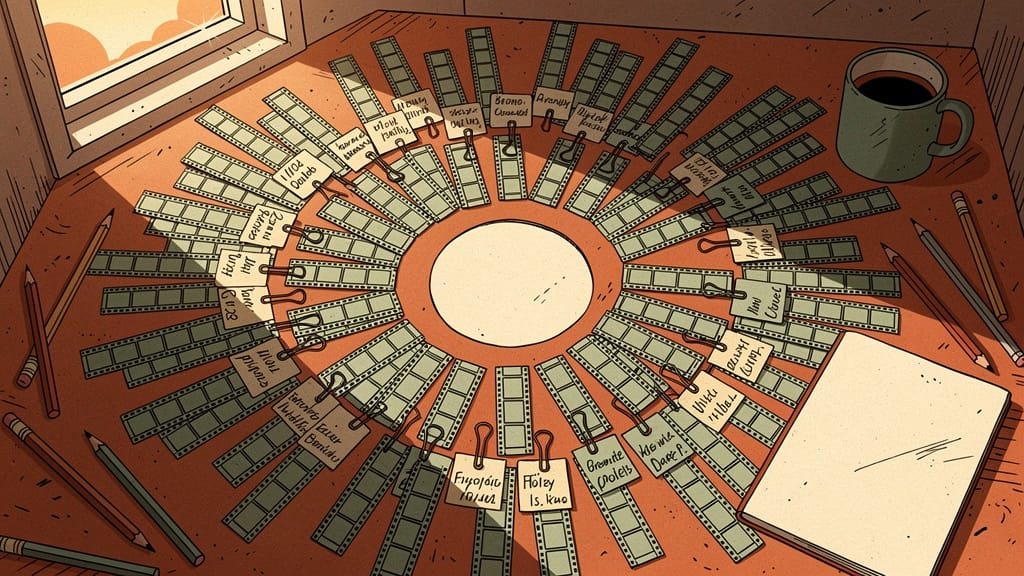
Some tasks are highly exposed. Logging and clip search — the work of tagging footage, identifying alternate takes, finding that one sound effect — is already automated in Adobe Premiere, which can now locate objects, people, alternate takes, and sound effects with a single click. DaVinci Resolve reads slate clapperboard details automatically and lets you search footage by content. These are hours that will compress, and in many workflows they already have.
Interview reduction and rough assembly are similarly exposed. Stephen Eckelberry has been cutting for 43 years — he started on a Moviola, splicing film by hand. On a recent documentary project, an eight-day shoot produced two commissioned episodes on a budget that, in his words, "didn't pencil out." He threw the interview footage into an AI tool and worked from what came back. The value wasn't a finished cut. It was a starting point to react to. His summary is the clearest description of this division of labor: "It doesn't do the storytelling for you — it just gets you started. There's an old saying: it's easier to rewrite than to write. I find that true."
Jesús Contreras, a documentary filmmaker and founder of Wachanos Media, put a number on it: AI saved him 20 to 30 hours in the early editorial stage alone on a single short documentary — the logging, reviewing, and hunting for structure that happens before a story can take shape.
It helps organize the clay, but I still sculpt the film.
— Jesús Contreras, Founder, Wachanos Media
Captions, localization, and social versioning belong in the same exposed category. Multiple language subtitles, styled single-word captions, and platform cutdowns are increasingly automated. Someone still needs to catch a mistranslated name or a caption that drops a negation. But the bulk of the mechanical work is shrinking.
Then there's the task that isn't moving: deciding what a story is about. Sergio Miranda built Serril Media into a post house serving Netflix, HBO, and Discovery. He used AI on an eight-year passion project with more than 40 interviews. The tool organized the footage. It missed the entire LA thread in one edit because nothing had told it what mattered. "The tool can organize the footage," he said. "It cannot yet feel what a story is about."
Your logging hours are the most exposed part of your job. Your editorial judgment — why this take and not that one, what this silence communicates, whose perspective the film is really about — is not exposed in the same way.
More Video, But Who Captures the Upside?
Knowing which tasks are vulnerable is clarifying. It doesn't answer the harder question: is there actually more paid work coming, or is the industry simply expecting more output from fewer people?
The demand-expansion argument is real. Wistia's 2026 State of Video report, drawn from more than 900 professionals and 13 million videos, found that AI users are 57 percent more likely to produce 50 to 100 videos and twice as likely to produce 100 to 250. They're also significantly more likely to make ads and product videos. The market for video is growing, and AI is one reason it's possible.
But the trust constraint is real too. Animoto's 2026 survey found that 77.9 percent of consumers trust videos featuring real people, and 36 percent say AI-generated videos lower their trust in a brand. Quantity and quality are on different trajectories — and quality still commands a premium.
Navik's situation after adopting AI tools illustrates how these two forces meet. His logging time compressed. He took on more projects. But the reason clients kept hiring him wasn't that he could produce clips faster — it was that he could find the story in the footage and make it feel made for a specific audience. The volume was a feature of the workflow. The judgment was the product.
The market will likely split. Low-context, repetitive, templated video work will flow toward self-service and compressed rates. High-context work — branded storytelling, documentary, factual, scripted post — retains the human premium because a wrong decision in those categories has real cost. The practical move is to evaluate whether your current clients value you for the speed of assembly or for the reliability of judgment. Those are different services, and they're increasingly priced differently.
The Part No One Wants to Say Out Loud
All of this is happening while the entry-level pathway into the profession is quietly narrowing — and that deserves more honesty than it usually gets.
A June 2026 analysis of 7.3 million Swiss job advertisements found that junior postings in 2025 were nearly one-third below the pre-AI average. In AI-exposed sectors, junior roles fell 16 percent while senior roles rose 26 percent. The study interprets this as employers placing greater weight on experience as simpler tasks migrate to tools.
PwC's 2026 AI Jobs Barometer, drawn from more than one billion job ads across six continents, found that AI-exposed junior roles are now seven times more likely to demand traditionally senior skills such as leadership and strategic thinking compared with the least-exposed junior roles. The entry-level job is compressing upward in expectation without necessarily compressing upward in pay.
The New York Fed's May 2026 analysis, using US job-posting data, found little evidence of a distinct AI-driven decline in labor demand for editors specifically, and found that junior and senior postings within highly exposed occupations moved broadly in parallel. The picture isn't settled. But the direction of pressure is clear.
It doesn't do the storytelling for you — it just gets you started. There's an old saying: it's easier to rewrite than to write. I find that true.
— Stephen Eckelberry, Editor, Innit Productions
For established editors, the junior-pipeline risk is also your risk. If fewer assistants are trained through paid work, the profession loses the people who would have grown into the next generation of senior editors. The practical response isn't to avoid tools — it's to use them in ways that create learning. Review model outputs alongside a junior. Explain why a suggested cut is wrong. Make the invisible editorial logic visible.
For mid-career editors, the junior warning signals something specific about which skills to demonstrate now. The market is beginning to expect senior-level judgment at every level. That's unfair pressure — but it's also an opening for editors who can show that their work isn't about moving clips, it's about deciding what the audience needs to feel.
Two Moves Before the End of the Week
Navik stopped dreading post-production. He didn't stop editing. The logging compressed; the story work expanded. His clients didn't notice the difference in his workflow. They noticed that he delivered faster and came to the story sooner.
That's the version of this transition worth aiming for — not the one where you race a model, but the one where the model handles the inventory while you make the decisions that determine whether a project lands.
The editors who will benefit from this shift aren't necessarily the fastest adopters of every new tool. They're the ones who make their judgment legible — to clients, to collaborators, and in their own pricing.
Two moves you can make before the end of the week.
First: run your next logging-heavy project through an AI tool, but measure total correction time — not just upload speed. If the tool saves net hours after review, add it to your standard workflow and document what it catches and misses. If it costs more time than it saves, you have an honest data point instead of a guess.
Second: add one explicit line to your next client proposal — "includes AI output review, continuity check, and accessibility verification." That's not padding. It's pricing the judgment the model can't supply, and it makes visible work that editors have always done invisibly.
As Aaron Butler, ACE — editor of Euphoria — put it: the heart of filmmaking is emotional connection with the audience, and that's something AI cannot replicate. Your job isn't to compete with the tool. It's to be the reason the tool is worth using.
Recommended Tools & Resources
Introduction to AI for Work
A no-code starting point for using AI responsibly at work — what it is, where it helps, and how to apply it.
Building Career Agility and Resilience in the Age of AI
Concise 30-minute course on reimagining your career as AI reshapes industries — covers developing human skills that stand out and harnessing AI in your current role.
TimeBolt
Automatically cuts silences and dead air out of video and podcast recordings — saves creators hours of tedious editing on every long upload.


