

Two Dispatchers, One Technology, Opposite Stories
In January 2026, Daniel Chanthabandith added a new title to his LinkedIn profile: Dispatcher at A1 Garage Door Service. But look at his headline and something is off — or rather, ahead. "Aspiring Operations Analyst | Field Service Optimization | Power BI | KPI & Revenue Analysis." That's not how dispatchers used to describe themselves. That's how they're going to have to.
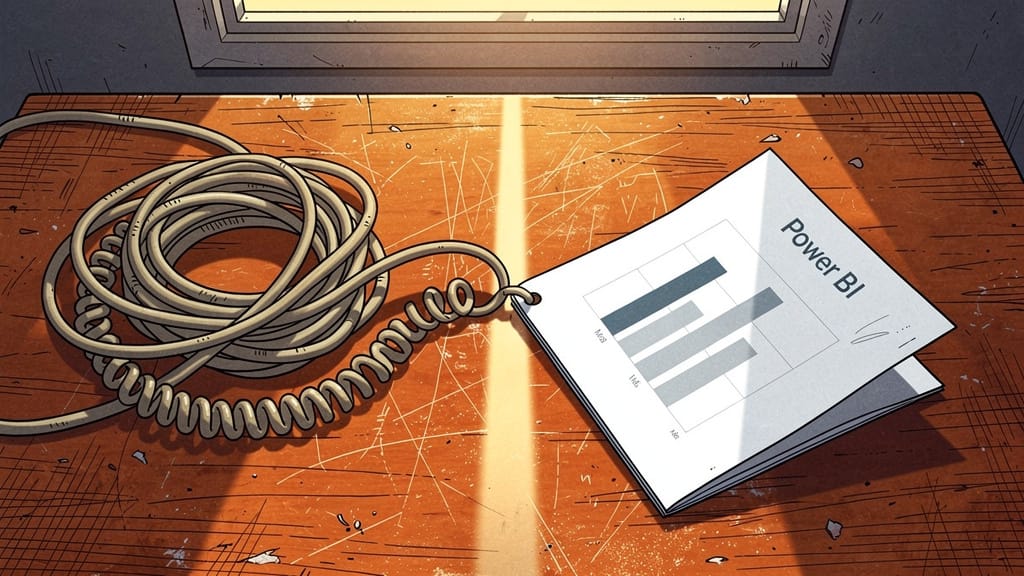
Around the same time, a 911 dispatcher posting under the name Successful-Debt2162 shared a different experience. His local agency had deployed AI to triage non-emergency calls, and "many times an emergency has been in progress and the AI machine couldn't tell. It's ridiculous."
Two dispatchers. Same technology. Divergent outcomes.
If you work dispatch — trucking, field service, 911, healthcare scheduling — you're already somewhere between these two stories. The question isn't whether AI is coming for your desk. It's which parts of your job each story describes.
But before you can choose a direction, you need a map — specifically, a task-by-task breakdown of what AI is actually automating in dispatch right now, versus what it still can't touch.
The Task Autopsy: Three Columns You Need to Know
AI is not coming for the dispatch job. It is coming for specific tasks inside it, and the split between automatable and judgment-dependent work is already empirically visible.
The first column — Already Automated — is filling up fast. C.H. Robinson compressed freight quote turnaround from 17 to 20 minutes down to 32 seconds after deploying AI-driven pricing and routing tools. That's not a future projection; that's a current deployment. Trimble's 2026 Transportation Pulse found 29% of carriers already using AI for load acceptance and dispatch decisions. In healthcare, AI schedulers are absorbing the front-desk triage layer entirely. In 911, roughly 64% of calls are non-emergency, and approximately 70% of those are now considered AI-manageable. Broker outreach, rate negotiation, load matching, check-calls, routine appointment booking, non-emergency triage — these tasks are migrating out of human hands right now, not in some projected future.
The second column — Becoming More Valuable — is where the real action is. Snohomish County, Washington deployed an AI called CORA alongside its dispatchers during a bomb-cyclone storm in late 2025. The AI fielded 2,500 non-emergency calls in 48 hours and correctly flagged 149 as probable emergencies — including a woman reporting her husband trapped between floors in a chair lift. The AI surfaced the call. A human dispatcher still owned the judgment call about how to respond. That split — AI for volume, human for stakes — is the pattern across every working deployment the research reveals.
The third column — Still Yours — is where dispatcher Reddit user lothcent put it plainly: "A computer can't calm a 23-year-old new mother through infant CPR. AI isn't going to convince a 6-year-old who called 911 to run to a neighbor's house for help when they find their diabetic dad passed out on the floor." That's not sentimentality. That's a precise professional claim about what category of task AI cannot replicate.
Every dispatch industry maps onto this framework. Trucking dispatchers: load searching lives in column one, carrier escalations live in column three. Healthcare schedulers: routine appointment booking is column one, urgent-case navigation is column two and three. Field service: job routing is column one, technician reassignment during a crisis is column two. The task audit is the same; only the industry vocabulary changes.
When people call 911 they want to talk to a human being, we know that, we want that.
— Kurt Mills, Executive Director, Snohomish County 911
The question you can run on yesterday's shift: what percentage of your eight hours was column one? The honest answer to that question determines the urgency of everything that follows.
The Displacement Side: What the Numbers Actually Show
Knowing which tasks are already automated is only half the picture. The other half is harder — what has actually happened to the people whose column-one work has been absorbed?
The displacement is real, measurable, and disproportionately quiet. C.H. Robinson cut roughly 1,400 jobs after rolling out AI-driven tools for pricing, scheduling, and shipment tracking, then trimmed additional senior managers in a separate March 2026 round. The Star Tribune confirmed these were not entry-level cuts. Across the full U.S. economy, Challenger, Gray & Christmas tracked 87,714 AI-attributed layoffs in the first half of 2026 alone, versus 54,836 for all of 2025. The acceleration is not subtle.
What's telling is the silence. No individual displaced dispatcher has publicly gone on record to say AI took their job. That absence doesn't mean displacement isn't happening. It may mean the people it's happened to haven't yet found a venue to say so publicly, or that the compression happened gradually enough that no single moment felt like a termination.
A working 911 dispatcher on Reddit named the business logic driving every deployment decision: "The inevitable is coming and it's probably coming faster than we think. Not only would it be able to do our job — it would do it with less mistakes and the big one — less of a liability."
That's the sentence that matters. It's not an industry analyst. It's someone on a dispatch floor reading the same direction of travel that executives read, and arriving at the same conclusion.
The Concerned Worker's anxiety has a legitimate foundation. The companies making these cuts are not small or experimental. C.H. Robinson is one of the largest freight brokerages in North America. This section of the story deserves to be looked at directly, not softened.
But C.H. Robinson's story has a second half that most summaries skip — and it's exactly what Chanthabandith saw coming.
The Reframe That Actually Works
The dispatchers keeping their seats as AI absorbs column-one tasks are not the ones who waited. They are the ones who moved the center of gravity of their role toward exception handling, data interpretation, and AI oversight before anyone asked them to.
Before joining A1 Garage Door Service in January 2026, Chanthabandith spent three years at Parker & Sons optimizing the daily allocation of more than 100 technicians using revenue and performance metrics. He ran Power BI dashboards, analyzed technician KPIs including conversion rate, average ticket value, and efficiency, and identified scheduling inefficiencies that reduced delays by 20%. He did not wait for dispatch to become an analytics job. He built the analytics skills while dispatch was still primarily a phone job, then brought both to his new title.
His LinkedIn headline is not a wish. It's a job description — one that says what the role is becoming and stakes his claim to be the person who does it.
Prior to Palantir, it was a laborious process and required multiple phone calls and time 24/7/365 making calls, as well as ad hoc meetings to review and discuss staffing.
— Meg Duffy, Senior Director of Staffing and University Outreach, Cleveland Clinic
This pattern isn't isolated to field service. ServiceTitan's 2026 State of AI in the Trades survey of 1,032 contractors found AI-powered dispatching is being deployed specifically to handle the routing and scheduling layer — the column-one work — while human dispatchers are being repositioned as performance analysts who supervise the AI's output and manage exceptions. The companies that report the strongest outcomes are the ones where the dispatcher owns the dashboard, not just the phone.
In Snohomish County, the human dispatchers who worked alongside CORA during the bomb-cyclone were not made redundant. They were elevated to the escalation tier — the 149 calls that required a human decision. At Cleveland Clinic, nurse staffing coordinators who traded Excel and sticky notes for an AI-powered platform became strategic partners rather than clerks. Different industries, same underlying move: claim the oversight layer before someone else does.
The reframe is available to any dispatcher willing to take it. The move is not primarily technical — Chanthabandith is not a software engineer. It is analytical: learning to read the output of AI routing tools, identify where they fail, and own the performance layer above the automation. That is column two and three work, and it is growing in value precisely because column one is being automated beneath it.
Who Controls the Pace — And Why That Matters
The reframe is real. But it comes with a hard prerequisite: you need to know which tasks in your current role are still yours versus which ones have already migrated to the machine — and you need to run that audit before your employer does it for you.
The dispatcher's transition is not purely an individual problem. It has a governance dimension, and in 2026 that governance is actively being negotiated between employers and labor.
Walmart deployed AI shift-planning tools that cut store-manager scheduling time from 90 minutes to 30 minutes across 1.5 million associates — a genuine productivity gain. Within months, AI-driven scheduling also triggered worker strikes when the system was used to reduce hours without worker input. The productivity gain and the labor conflict came from the same deployment. The difference was not the technology — it was whether workers had any say in how it was used.
DHL Teamsters ratified a new four-year contract in 2026 by a 92% margin. The deal included a 20% wage increase and, critically, explicit job protections tied to AI and automation deployment. Bloomberg Law confirmed that unions across multiple industries are now prioritizing AI language in collective bargaining — not as a future-proofing measure, but as an immediate 2026 priority.
Dispatchers in unionized workplaces have a structural lever that non-union workers lack. But even non-union dispatchers benefit from understanding that the pace and terms of AI deployment are negotiable, not fixed. Employers who want smooth deployments have an incentive to involve dispatchers in the transition design. The Walmart case proves that algorithmic scheduling without worker input produces backlash. That's leverage, if you know to use it.
Which brings the question back to the individual level: given what you now know about the task breakdown, the displacement reality, the reframe path, and the governance options — what do you actually do this week?
The Map You Should Have Drawn Yesterday
Chanthabandith's LinkedIn headline — "Aspiring Operations Analyst" — was not optimism. It was a map he drew for himself before anyone gave him one. Successful-Debt2162's documentation of AI triage failures was not obstruction. It was professional accountability that the technology still requires humans precisely because of moments like the ones he described. Both responses have a place. The dispatchers most at risk in 2026 are not the ones AI is actively replacing. They are the ones who haven't yet looked at the map.
One number reframes everything: O*NET projects -1% employment change for dispatchers through 2034 — nearly flat headcount — alongside a 100% AI exposure score for the role's task content. The job survives. The job description does not. The gap between those two facts is where every dispatcher's next decision lives.
This week, write down every task you performed yesterday. Mark each one: Automated (AI already does this at scale), Automatable (AI will do this within two years), or Judgment-dependent (requires human escalation, relationship context, or de-escalation). That list is your personal task audit. The ratio of column one to column three tells you how much time you have — and where to start moving.
The dispatchers who are buying themselves time aren't the ones waiting to find out if they're being replaced. They're the ones who already ran the audit.
Recommended Tools & Resources
Introduction to AI for Work
A no-code starting point for using AI responsibly at work — what it is, where it helps, and how to apply it.
How to Use AI to Supercharge Your Job Search
Practical 2-hour course on using AI to write resumes, craft cover letters, and prepare for job interviews — the best of a weak category for AI job search courses.
Introduction to Power BI
Building dashboards and reports in Power BI — one of DataCamp's most-taken courses.


