

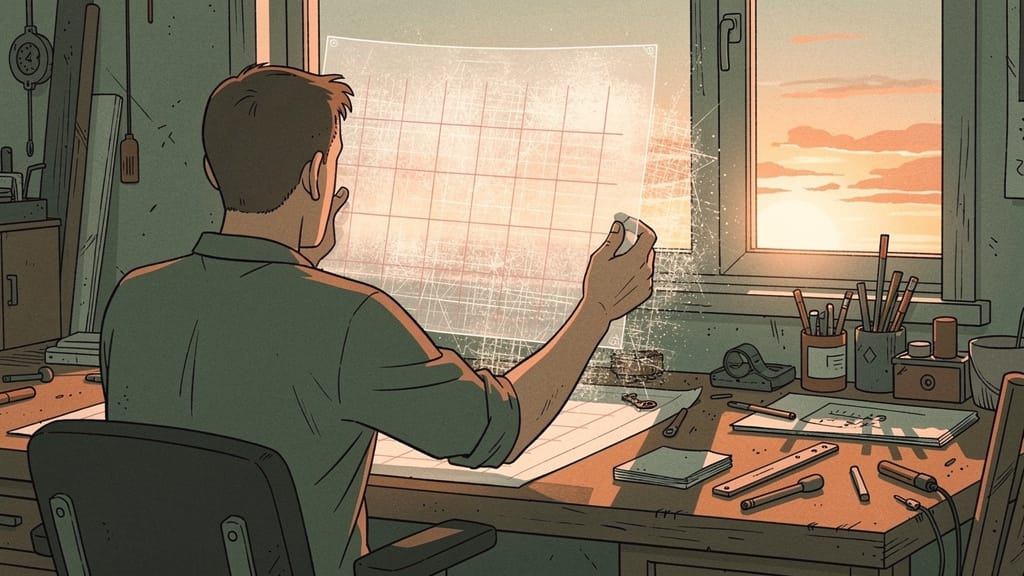
Kaleigh Post had 10 years in print and graphic design when she started noticing something: she kept gravitating toward the technical conversations in meetings, the ones about how things were built rather than how they looked. So she did something that scared her. She enrolled in a nine-week coding bootcamp with limited savings and no guaranteed job waiting at the end. "Switching from graphic design to software engineering has been challenging and a bit scary," she said later, "but it's been so rewarding." After the bootcamp, she joined Tucows as a Design Engineer — a bridge role that let her use both skill sets simultaneously — before moving into a full software engineering position at Wavelo.
She's one of a growing number of graphic designers quietly exiting the field, not in panic, but in response to something measurable. The World Economic Forum has flagged graphic design as the 11th fastest-declining job globally. Nearly half of routine design tasks — template layouts, basic photo editing, initial logo concepts — are projected to be automated by 2030. The Bureau of Labor Statistics projects just 2% growth for graphic designers through 2034, compared to 7% for web developers and digital interface designers.
The question isn't whether the field is changing. That's settled. The question is where to aim, and how much time the transition realistically takes.
The Destination Roles — and What They Actually Pay
Four paths account for most successful graphic design pivots, and they are not equally accessible or equally rewarding depending on where you're starting.
The pay gap is real and widening. Graphic designers earned a median of $61,300 in 2024, according to BLS data. Product designers cleared a median of $118,000 and UX designers $109,000, according to Glassdoor's 2025 and 2026 figures. That's not a marginal difference. It's a different income bracket — and a different ceiling.
The demand picture reinforces the urgency. Web developers and digital interface designers are projected to grow at 7% through 2034, more than three times the rate for graphic designers. And within design hiring, the market has shifted heavily toward experience: 56% of hiring managers are now prioritizing senior design hires, compared to only 25% hiring for junior roles, according to Figma's State of Designer 2026 report.
Here's how the four main paths break down. The UX/UI Designer path has a realistic transition timeline of 12 to 18 months, a salary range of $83,000 to $109,000, and one primary skill gap to close: user research and usability testing. The Product Designer path takes 15 to 24 months, commands $109,000 to $155,000, and requires building data fluency and cross-functional leadership alongside the visual skills you already have. The Web and Motion Designer path is the fastest, often achievable in 6 to 12 months, with salaries ranging from $80,000 to $98,000 — the main gap is Figma prototyping or After Effects paired with Lottie for animation handoffs. The Founder and Entrepreneur path is the most variable: 12 to 24 months to stability, highly variable income, and a significant gap in business operations and wholesale or sales mechanics.
For most graphic designers, the UX/UI path offers the most direct route: the visual skills transfer immediately, and the salary jump is meaningful within 18 months. The Product Designer path pays more long-term but demands a harder mindset shift — from "how does this look?" to "how does this perform, and how do I prove it?"
Whether your background is in print, packaging, editorial, or in-house brand work, the visual foundation is transferable. What varies is the size of the research and systems thinking gap you'll need to close.
How Long It Actually Takes
Knowing the destination is useful. But the question that actually determines whether someone moves is more concrete: how long does it take, and what conditions make the difference?
Graphic designers have made this transition in as few as 5 months and as many as 18. The difference is almost entirely explained by intensity of study, financial runway, and how closely the destination role maps to existing skills.
The fast track looks like Vince MingPu Shao, who left his graphic design job and studied roughly 48 hours per week for 5 months, building a portfolio site as his primary credential. He landed a front-end developer role at a design agency. The conditions: no dependents, limited savings, extreme time investment, and a destination role with high skill adjacency to his existing visual work. Five months is achievable, but it requires treating the transition as a full-time job.
I left my graphic design job at the end of February. With no elaborate plan and limited saving in the bank, I started my journey of transforming into a front-end developer.
— Vince MingPu Shao, Front-End Developer
The standard path looks like Daniela Muntyan, who planned her pivot for 18 months while still employed — spending evenings building websites on no-code tools and taking a structured UX course before sending a single application. She landed product design roles at multiple companies and is now a product designer at Figma. The conditions: employed throughout, gradual skill-building, deliberate portfolio construction before any job search began. This is the lowest-risk version of the transition for anyone with financial obligations.
The long game looks like SaVonne Anderson, who spent 6 months planning and 7 months running her stationery business as a side hustle before leaving her graphic design role at a New York art museum. By the end of year one, she had wholesale deals with major retailers. The conditions: clear product-market insight, production skills that transferred directly, and a willingness to learn business operations from scratch.
The practical rule of thumb: if you're targeting UX, you likely already have the visual foundation — the gap is process documentation and portfolio framing. The further you're moving from visual work, into code or business ownership, the longer the runway you'll need. If you can build while employed, that's the lowest-risk version of any of these paths. You don't have to choose between income and reskilling for the first 12 months.
What You Already Know, and What You Need to Build
Graphic designers typically overestimate how much they need to learn and underestimate how much they already know.
Visual hierarchy and layout translate directly to UI structure. Brand systems thinking translates to design system thinking. Typography and color become interface craft. Production and file management become handoff discipline. Client communication becomes stakeholder management. These are not stretch claims — they're the reason hiring managers consistently tell career changers that their visual backgrounds are an asset, not a liability.
The gaps are real but concentrated. User research and usability testing need to be built. Component states and interaction design need deliberate practice. Figma prototyping and auto-layout require hands-on time. Metrics fluency — understanding what "good" actually looks like in data — requires a mindset shift. And accessibility fundamentals, specifically WCAG standards, are now a baseline requirement across most product and UX roles, not a specialty.
This is where Kaleigh Post's path offers a tactic worth understanding. Her Design Engineer role at Tucows wasn't a consolation prize on the way to a real engineering job — it was a strategic position that let her charge for the skills she already had while building the ones she was missing. She didn't leap from graphic design to software engineering. She crossed in two steps, with a paying job in the middle.
That bridge role principle applies across the UX and product design space. A junior product designer role, a hybrid web designer position, or a design systems contractor engagement can each function as a paid reskilling environment. The research supports targeting these roles aggressively: 69% of marketing and creative leaders say AI is reshaping the skills they need on their teams, and the shift is toward strategic and systems-oriented design — not away from visual craft entirely. The skills that transfer are the ones that can't be generated by a prompt.
I started this company because of a problem. I was frustrated by my experiences looking for great cards to celebrate my loved ones year after year, looking for a card to celebrate my Black dad on Father's Day, and not finding anything that looked like him.
— SaVonne Anderson, Founder and CEO, Aya Paper Co.
For anyone who's been treating "I'm not a UX designer yet" as a reason not to apply, this reframe matters. You may already qualify for hybrid roles that will pay you while you close the remaining gaps. Whether you're coming from an agency, an in-house team, or a freelance practice, the question isn't which specific subspecialty you're leaving — it's whether you can reframe your existing work in terms of problems solved and outcomes measured, rather than deliverables produced.
What Credentials Are Worth It — and Where the Market Has Tightened
Structured programs can accelerate the transition. But the market for junior UX and product roles has tightened significantly since 2022, which means the credential itself is less important than the portfolio evidence that comes with it.
The numbers are sobering. Only 49.5% of designers secured a new role within 3 months in 2024, down from 67.9% in 2019. Less than 5% of tech companies are currently open to hiring entry-level talent, according to Her UX Path's 2026 analysis. The junior pipeline is not the same market it was when most bootcamp job-placement statistics were generated.
Design recruiter Hang Xu, writing for the Nielsen Norman Group in January 2026, put it plainly: "Oftentimes, you're being evaluated by a recruiter who's never done design before, by a hiring manager who might be a PM, or a founder who's never even worked with design. They're not looking for a lesson or a quick course on what design is. They're trying to solve their own problems." The implication for anyone building a portfolio: a case study that shows a problem, a process, and a measurable result will outperform a gallery of beautiful screens almost every time.
Structured bootcamp programs with verified placement data report roughly 85 to 93% of job-qualified graduates receiving offers within 12 months — but "job-qualified" requires completing the program, applying consistently, and continuing to upskill after graduation. The outcome data does not apply to passive job seekers.
The designers who broke through the current market consistently did one of two things: they targeted bridge or hybrid roles rather than pure junior UX titles, or they focused their applications on sectors with active digital transformation hiring — healthcare, government, and finance — rather than the tech company junior pipeline that has largely closed. If you're evaluating a bootcamp, look for programs with publicly audited placement data and plan your application strategy around those sectors from day one.
What the Transition Is Actually For
Kaleigh Post didn't quit graphic design in a panic. She paid attention to what was pulling her forward — toward technical conversations, toward building things — and followed it deliberately. The bootcamp was the move she made once she knew the direction. The bridge role was the move that kept her solvent while she built the new skill set. Neither required certainty before she started.
The skills that made you a good graphic designer — systems thinking, translating abstract ideas into concrete visual form, holding a user's attention across a layout — are exactly what distinguishes a strong product or UX designer from a bootcamp graduate with Figma fluency and nothing else. You are not starting over. You are translating.
One exercise worth doing this week: take one past project — a brand identity, a campaign, a website — and write three sentences about it from the outside in. What problem existed before this project? What decisions did you make to address it? What changed for the person using it? That's not a portfolio piece yet. It's a proof of concept — for yourself — that you already think like the designer you're trying to become.
The transition is not about abandoning what you know. It's about finding the work that makes what you know worth more.
Recommended Tools & Resources
Building Career Agility and Resilience in the Age of AI
Concise 30-minute course on reimagining your career as AI reshapes industries — covers developing human skills that stand out and harnessing AI in your current role.
DataCamp
Hands-on learning for data science, AI, Python, and SQL — built for working professionals who want real skills, not just theory.
ChatGPT Masterclass: The Guide to AI & Prompt Engineering
Comprehensive 23-hour course covering everything from writing professional emails and reports to building resumes and prompt engineering — the Swiss Army knife of ChatGPT courses with 47K students.


