

You've done it. Maybe last Tuesday, maybe ten minutes ago — you opened a tab, pasted something you probably shouldn't have, and got exactly what you needed in under a minute. The document got finished. The meeting went well. Nobody asked how.
You're not an outlier. According to the Microsoft and LinkedIn Work Trend Index, 78% of employees now bring personal AI tools to work without employer approval. Three in four of those workers don't tell anyone. The phenomenon even has a name — shadow AI — and the people doing it range from entry-level coordinators to, as Politico reported in January 2026, the acting director of the Cybersecurity and Infrastructure Security Agency, who uploaded sensitive government files to public ChatGPT. If the person responsible for protecting America's critical infrastructure couldn't resist the shortcut, the judgment you've been applying to yourself probably needs recalibrating.
Then there's Matt. The Berlin-based business consultant discovered ChatGPT shortly after its launch and never looked back. He and a colleague began using it — then Perplexity — hundreds of times a day on their work laptops. In the office, he occasionally dimmed his screen to hide queries from nearby colleagues. Senior management praised his work and discussed his performance with executives who never knew what was behind it. He called the discovery "like finding a video game cheat." As of his BBC interview, he had no plans to stop.
The question worth sitting with isn't whether you should have done it. It's what separates the Matts from the workers who didn't fare quite as well — and one of those variables isn't the AI at all.
But "everyone does it" has never been a complete risk analysis. Three variables separate the workers who got away with it from the ones who didn't — and one of them isn't the AI at all.
What Actually Goes Wrong
Most shadow AI incidents don't fail because of the tool. They fail because of what gets pasted into it, or because the person using it panicked when asked about it directly.
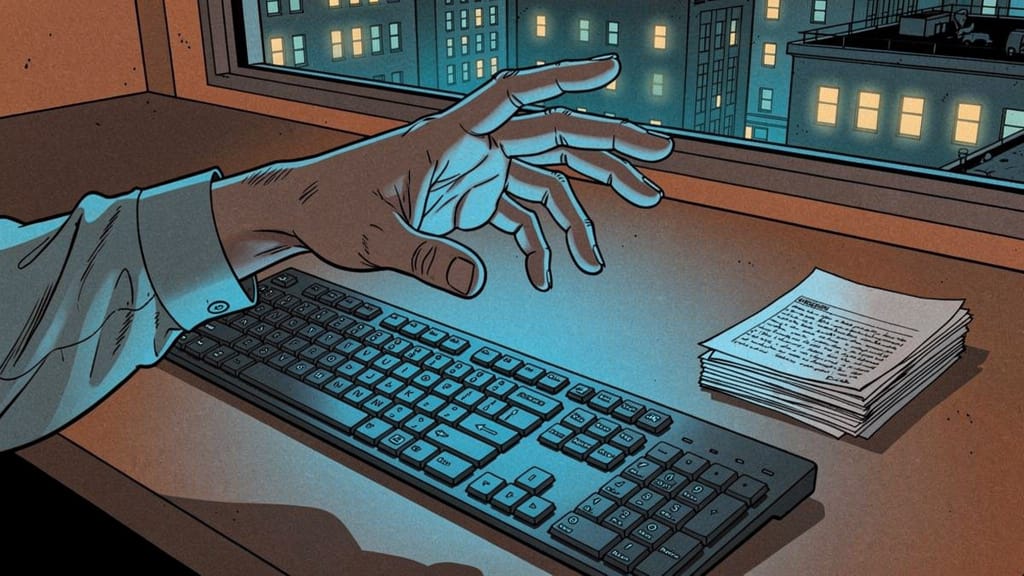
Consider what happened to an operations worker at a small company — posting as LateProposalas on Reddit's r/careeradvice in August 2025 — who used ChatGPT as what they called an executive-function prosthetic. Follow-up emails, tracking spreadsheets, structured reports. Tasks that they kept dropping before; tasks that now got done consistently and well. Output improved so noticeably that the boss confronted them directly. The employee's response: "I said no at first, but he kept pushing." Trust never recovered. Not fired — just permanently damaged. What's striking is that the AI was working exactly as any sensible organization would want it to work: a person with a genuine organizational weakness found a tool that compensated for it and produced better work. The tool wasn't the problem. The lie was.
The details change by role — a marketer pasting a client brief, a paralegal summarizing case notes, a recruiter dropping candidate data into a tool — but the arc is the same: the tool worked, the improvement showed, and the question came.
Shadow AI isn't a technology problem — it's a trust problem. What we're seeing across workplaces is employees quietly turning to AI tools that leadership hasn't approved, not because they're trying to be rebellious, but because they're trying to survive the pace of work.
— Jason Greer, Founder of Greer Consulting
At scale, the same pattern played out at Samsung Semiconductor in April 2023. Three separate engineers pasted proprietary source code, chip-defect detection algorithms, and an internal meeting transcript into ChatGPT in a 20-day window. None were trying to steal anything; all were trying to work faster. The result was a company-wide ban and an internal AI environment with strict size limits. The employees were trying to solve the same problem LateProposalas was trying to solve. Confidential data landed somewhere the company couldn't retrieve it.
Research tracking 1.6 million workers found that 11% of data employees paste into ChatGPT is confidential — not malicious exfiltration, but documents, code, and client data shared incidentally while getting work done. The Samsung story isn't the cautionary tale of bad actors. It's the cautionary tale of normal people making normal decisions that turned out to be irreversible.
Which raises a practical question: what data is actually dangerous to share, versus what's just mildly inadvisable? The answer is more specific than most people realize — and it's the first of three things worth getting clear before you paste anything again.
Three Questions Before You Paste
Most shadow AI risk concentrates in a narrow, identifiable category of inputs. Cyberhaven's breakdown shows what actually flows from enterprises into AI tools every week: roughly 319 internal strategy documents, 278 instances of source code, and 260 client data entries per 100,000 employees. That's where the real exposure lives — not the meeting agenda you're reformatting or the email you're polishing.
Three questions can help you evaluate your own behavior before the next paste event, and each takes under a minute.
First: Is this data yours to share, or does it belong to a client, a patient, a candidate, or a deal? Anything with someone else's name, number, or proprietary process attached is a different category than your own draft thinking.
Second: Would the output reveal what went in? If your AI-assisted deliverable is so dramatically better than your usual baseline that someone will notice and ask, you should have an answer ready that isn't a denial.
Third: Does your employer have an AI policy, and have you actually read it? This matters more than it might seem. Roughly 43% of organizations have no policy at all. If yours is in that group, you're not violating rules — but you're also not protected by them. The data risk exists regardless of what the policy says or doesn't say.
Matt never lied about what he was doing — he just never volunteered it. That's a different calculation than denial.
Jason Greer, founder of Greer Consulting, put it plainly in an interview with the Rochester Business Journal: "Shadow AI isn't a technology problem — it's a trust problem. What we're seeing across workplaces is employees quietly turning to AI tools that leadership hasn't approved, not because they're trying to be rebellious, but because they're trying to survive the pace of work." That framing matters, because it gives you a way to talk about this — if and when the conversation comes — that is accurate, not defensive.
The riskiest inputs tend to cluster in the same places regardless of industry: anything with a name attached to it, anything under NDA, and anything that would embarrass your employer if it surfaced in a breach notification.
Even workers who are careful about what they share face a second question that's harder to answer alone: what happens if someone asks? And the people best positioned to help — your employer's IT or legal team — are often working from incomplete information about what's already happening in their own organization.
Your Employer Is More Confused Than You Think
Here's the organizational picture most workers don't see from the inside: the people setting the rules are frequently the people most aggressively breaking them.
More than 80% of workers use unapproved AI tools, including nearly 90% of security professionals, according to research from Upguard and Cybersecurity Dive. A separate UK study found that 62% of senior leaders use unauthorized AI at work. The executives who might discipline you for doing this are, statistically, doing the same thing. The policy prohibition is often less a coordinated security posture than it is a governance gap that nobody has gotten around to closing.
You can't audit how AI thinks, but you can audit what it does.
— Wade Bicknell, CISO of the CFA Institute
This explains something that might otherwise feel contradictory: 75% of employees who use AI at work keep it secret, not because they're all certain they'd be fired if caught, but because the culture of secrecy is self-reinforcing. When nobody talks about it, the absence of visible AI use becomes the perceived norm — even when the actual norm is exactly the opposite.
The data suggests a cleaner path than continued hiding. When employers provide sanctioned AI alternatives, unauthorized usage drops by 89%, according to a Healthcare Brew survey. That number holds whether you're in a five-person startup or a 50,000-person enterprise — when people have a tool that works and a governed version becomes available, most of them switch. This isn't compliance out of obedience; it's a preference for working without the low-level anxiety of a hidden tab.
That holds whether you're in a five-person startup or a 50,000-person enterprise — the dynamic is the same: when people have a tool that works, they use it; when they're given a better-governed version of the same tool, most of them switch.
Which brings the question back to Tuesday — or whenever you next open that tab. You can keep doing what you've been doing. A lot of people will. But you now have enough information to make that a choice rather than a habit.
What to Do Before You Paste Again
Matt is still dimming his screen somewhere in Berlin. He was praised, not fired — but he was also careful about two things that weren't accidents. He didn't paste client data or proprietary source code. And when the productivity gap became visible and management started talking about his performance, he had a ready answer that wasn't a lie. Those were decisions, not luck.
The secrecy doesn't feel like the risky option, but it often is. The most dangerous version of shadow AI isn't being caught using the tool — it's being caught having shared the wrong data, or being caught denying it in the moment and turning a conversation about tools into a conversation about honesty.
Before the next paste, run the three questions in under two minutes: Is this data mine to share? Would the output reveal what went in? Does a policy exist and have I actually read it? If the answers come back clean, your risk is low. If they don't, that's the signal to either change what you're pasting or start the conversation with your employer you've been avoiding.
That conversation doesn't have to be a confession. "Here's what I've been using, here's the productivity impact, here's what a sanctioned version would fix" is a proposal, not an admission. The 89% reduction in unauthorized use when approved alternatives exist is your opening argument. The fact that your senior leadership is almost certainly doing the same thing is your context.
The tab isn't going to close itself. But you can decide what goes into it.
Recommended Tools & Resources
Proton VPN
VPN with a genuinely free tier and a strict no-logs policy — open-source apps and 20,000+ servers, from the Swiss team behind Proton Mail.
Co-Intelligence: Living and Working with AI
The definitive guide to working alongside AI — Wharton professor Ethan Mollick proposes four principles for using AI as a collaborator, with actionable strategies for any profession.
The Complete Prompt Engineering for AI Bootcamp
Practical 22-hour bootcamp covering prompt engineering for GPT-4, image generation, and real-world AI tool usage — with 15+ hands-on projects.


